Showing posts with label history. Show all posts

Thursday, October 31, 2013

Happy Halloween: The Hoosac Tunnel

Photo uploaded by zaigee on Flickr

The Hoosac Tunnel is an almost five mile long tunnel that runs from Florida, Massachusetts to North Adams Massachusetts through the Berkshires. It is the longest, still operational, transportation tunnel east of the Rocky Mountains. Today, the tunnel is only used by PanAm Railways which runs freight traffic through the tunnel

The Hoosac Tunnel was first proposed in 1819 as an underground canal beneath the Berkshires as a way of providing a passage way for goods and raw materials between Boston and points west. With the invention of the steam locomotivewthe tunnel plan was re-evaluated and re-proposed for railway traffic. Work officially commenced in 1851 by the Troy and Greenfield Railroad Company. It would take 24 years and $21 Million dollars to complete. 

Initially the tunnel was to be constructed using a 70-ton steam-driven boring machine. The machine however seized up on a test run and could not be used for construction. Following this failure, the work was done by means of hand-drills and gunpowder. That was until the invention of  nitroglycerine.  The nitro proved to be a very powerful and extremely unstable explosive that resulted not only in successfully blasting the length of the tunnel, but also in killing dozens of men in its use.

The tunnel was considered an engineering marvel when it was completed in 1875. Yet, it would cost 195 lives in various fires, explosions, and tunnel collapses, hence earning its name among the crew as the "Bloody Pit". Today, it is also said to be one of the most haunted places in New England.


Ghost Stories

After the accidents began piling up during the construction many workers came to feel that the tunnel was cursed and many of them refused to enter it again. Some of the crew members simply walked off the job and did not return.

1: Murder ?: On the afternoon of March 20, 1865, three explosive experts named Ned Brinkman, Billy Nash and Ringo Kelley decided to use nitroglycerine to continue their work on the tunnel. They placed a charge and then ran back toward a safety bunker that would shield them from the effects of the blast. Brinkman and Nash never made it there however. For some reason, Ringo Kelley set off the charge before the other men could make it to shelter. The two men were buried alive under tons of rock. Soon after the accident, Kelley vanished without a trace, leading many to believe that the "accident" with the nitro may not have been an accident after all. He was not seen until a year later when his body was discovered inside the tunnel. It was found at almost the exact spot where Brinkman and Nash had been killed. The authorities quickly deduced that Kelley had been strangled to death. The death was thoroughly investigated but no suspects were ever found and the crime went unsolved.

2: On October 16, 1874 a local hunter named Frank Webster vanished near Hoosac Mountain. Three days later, he was found by a search party, stumbling along the banks of the Deerfield River. He was in a state of shock, mumbling incoherently and falling down. He explained to his rescuers that strange voices had ordered him into the Hoosac Tunnel and once he was inside, he saw ghostly figures wandering around. He also said that invisible hands had snatched his hunting rifle away from him and that he had been beaten with it. He couldn’t remember leaving the tunnel. Members of the search party recalled that Webster did not have his rifle when he was found and the cuts and abrasions on his head and body did seem to bear evidence of a beating.

3: In 1994 Kevin from Boston reported that while in the old control room opposite the ventilation shaft he heard "whisperings" and a "shape" about three feet tall and completely black staying just outside of the edge of his flashlight beam. "It always stayed just outside the beam about 20 feet distant, I have to conclude it was the light that kept it away from me. What I saw was real and moved with deliberation and I didn't have reason to believe it was friendly."

Locals in the area still claim that strange winds, ghostly apparitions and eerie voices are experienced around and in the daunting tunnel. Some researches have left tape reorders in the tunnel and have reported hearing what seems to be muffled voices when they play back the tape. There is also rumor of a hidden room in the tunnel. The room is said to be bricked up and house unspeakable horror.

HAPPY HALLOWEEN!

Sunday, March 4, 2012

Guest Post: Farewell From The Fifth Car


Here is our second guest post! This article is written by Scott Page, a 21 year old Bunker Hill Community College student and MBTA historian! You can follow Scott on Twitter (@ScottPage10690)!

MBTA to end 110 year old tradition of 
Two Person Train Operation


Shortly after 12:30am every night the last Red Line train of the day closes its doors and departs Ashmont Station in Dorchester embarking on a thirty-seven minute voyage to Alewife Station in North Cambridge. This typically mundane trip is often the last source of transportation for evening-shift workers, late night partiers, and the occasional drunk. But on the wee morning hours of Saturday March 24th, 2012 the 12:30am train will receive the historic distinction of being the last MBTA Rapid Transit train to run with an on board Train Attendant – thus unceremoniously bringing an end to a one hundred and ten year old Boston transit tradition. 
An MBTA Train Attendant cycles the doors 
at Wollaston Station on the Red Line. 
Currently the MBTA operates each Red Line train with a two person crew. The practice, known in the transit industry as Two Person Train Operation, involves a Motorperson in the first car, who is responsible for operating the train and overseeing safety along the right-of-way; and a Train Attendant in the fifth car, who cycles the doors at stations, announces stops, and oversees the safety of passengers both on the train and on the platform. 
The practice stems from the early days of subway and elevated operations when train doors literally needed to be cranked open by Attendants standing between each car. Modern technology now allows for doors to be controlled from a central point which, here in Boston, is controlled by the Train Attendant in the 5th car. 
The MBTA claims that eliminating Train Attendants from the Red Line and transferring all duties to the Motorperson, a practice known as One Person Train Operation, will enable the Red Line to operate more trains during off-peak hours and save money that the cash-strapped transit authority can reinvest into the line. If this proposal sounds familiar, that’s because it is. 
In June of 2010 the MBTA removed the second operator from all Orange Line trains in a similar cost savings effort. The T reassured riders that there would be no change in service and safety, but just six months after its transition the Orange Line suffered its worst performing winter in the last quarter century. Massive delays snarled the line leaving passengers out in the cold. While delays were not the direct result of One Person Train Operation the overwhelming response from riders was that additional uniformed personnel was needed to relay pertinent information.
To ensure passenger safety on the Red Line under One Person Train Operation the MBTA has installed a series of mirrors and closed-circuit television monitors at each station to show the Motorperson the entire platform. These devices will be most useful at stations with curved platforms where the Motorperson cannot see the entire train by line-of-sight alone. Train Attendants, for the record, have no obstructed views of the doorways at any point in the system.
But with recent breakdowns and service disruptions still on many riders’ minds some aren’t so sure that having one crew member on board is a good idea. 
“Having one operator being responsible for hundreds of riders’ safety is quite daunting” said Jessica Baldeck, a frequent Red Line commuter and UMass Boston student. “I can’t think of any other situation where one person is solely in charge of handling hundreds of people - especially during an emergency.”
“Personally it makes me feel safer knowing there is someone on board whose sole job is to make sure everyone is riding safely” added Jessica Griffiths Sheldon, who occasionally takes the T into the city.
Train Attendants serve as a passenger liaison from the 5th car.
The MBTA cites that OPTO is becoming the industry standard for subway operations around the globe along with the conversion of the Blue Line in 1996 and the Orange Line in 2010 as the reason for converting the Red Line. Former MBTA General Manager, and current Secretary of Transportation Richard Davey said “We remain focused on identifying cost savings measures that helps us operate more efficiently.  The expansion of Single Person Train Operation… allows us to contain costs while maintaining quality service.”
Critics of OPTO note that Chicago’s CTA, which converted in 2001, has had several attempts by city Aldermen to bring back second operators after doorway safety incidents and crime rose on ‘El’ trains.
The MBTA, which is now engaged in an ongoing public debate over whether or not to raise fares and cut services, originally planned the conversion of the Red Line for September of 2011. The transition was pushed back to March of 2012 after various groups raised concerns over everything from doorway safety to on board crime. The T has used the additional seven months to give all Red Line Motorpersons additional training on proper doorway safety standards and evacuation protocols. 

The ring of the starter bell at 12:30am on March 24th will signal the end of an era in Boston transit. While most riders won’t notice the changes on an average trip, it’s imperative to remember the work done by Train Attendants in their one hundred and ten years of service. They’ve acted as visible representatives of the Authority – answering questions for tourists, giving directions to riders, and aiding in breakdowns and evacuations. But most importantly they’ve protected their riders from threats to safety – like the Orange Line Train Attendant who stepped in and prevented a hate crime in March of 2010 by sheltering the victim in his cab until police arrived. After Boston removes it’s Train Attendants from service this March only New York’s MTA, Toronto’s TTC, and the Port Authority Trans-Hudson railroad of New York and New Jersey will utilize Two Person Train Operation.

Saturday, December 24, 2011

Commuter Rail to New Hampshire

As most of you know the MBTA's Commuter Rail system only crosses state lines (into Rhode Island) on the south side of the system. It has been proposed for many years however, to extend some of the north side lines into the state of New Hampshire.

Before the days of MBTA.com
these pamphlets could be found for each line!
To think NH-Zone 13 was $6 1-way!
First, let me give a brief history of the MBTA trying to bring passenger rail back into the state of New Hampshire. During the 1980's the Boston and Maine Railroad (B&M) was the contractor for the MBTA Commuter Rail system (just like the MBCR today). On January 28, 1980, the B&M started an experimental service  that would run from Boston's North Station running along the Lowell line and eventually merging onto the New Hampshire main line terminating in Concord NH. It was dubbed the "Minute Man Service". This service was very popular among tourists, but it was not as popular as the B&M had first hoped it would be, resulting in federal funding being taken away and causing its demise on March 1, 1981, only a year after it first started operating.

B&M "Minute Man Service" near North Chelmsford, MA
After the Minute Man Service's early demise, it would take until 2008 for legislation to come about that might actually allow MBTA Commuter Rail to travel into NH. In July of '08 the New Hampshire Rail Transit Authority proposed a plan to extend MBTA Commuter Rail from the current Lowell terminus to Downtown Manchester, NH. The project would create nine new stops: North Chemlsford, Tyngsboro, Nashua, NH (Pheasant Lane Mall), Merrimack, NH, Manchester Regional Airport, and Downtown Manchester, NH. The plan also called for 12 to 15 round trips per day during weekdays and eight to ten round trips per day on weekends. The plan even received a total of $41 Million in Federal Grants to help fund the planning of the project. In early 2011 however, a bill was introduced into the New Hampshire legislature that would end the project's planning and give up its federal funding. Currently the project is still in limbo and, unfortunately, no one really knows what will come next.


Although the fate of this project is uncertain, another project is currently making headlines. The MBTA, NHDOT, Rockingham Planning Commision, and the Town of Plaistow New Hampshire are all working together to try and extend the MBTA's Haverhill Line from its current terminus in Downtown Haverhill to Plaistow, NH and relocate the current layover facility in Bradford to a new location on the border of Atkinson, NH. The project is currently set to cost around $25.5 Million. The projects largest obstacle however, is opposition from residents who do not want a layover facility in their area. 


The layover station has been located at Haverhill's Bradford commuter station since 1987. It is extremely small and has no room for expansion. Neighbors of the facility have complained for years that the idling trains wake them up in the early morning hours and send fumes through the open windows of homes during the summer. The new layover facility, which would be located in Atkinson, could accommodate six train sets, allowing for anticipated service expansion on the line. Like many of the MBTA's new layover facilities, when the trains are stored, they will be connected to the yard's power to allow for the train systems to run without use of power from the locomotive. The state-of-the-art energy controls and electrical systems will allow the MBTA to prohibit idling when an engine is not in active service. The facility would be owned by the NHDOT, and would be leased to the MBTA for operation.


The people of Atkinson really dislike the idea of this facility. This past Monday, December 19, 2011, The Plaistow Area Transit Advisory Committee met for the first time in more than 10 years to discuss the project. The meeting, which took place at the Atikinson Community Center, was attended by many Atkinson residents and local state officials. The meeting eventually turned into a shouting match between residents as committee member Tim Moore tried to explain the facts of the project. According to The Eagle Tribune, the meeting got out of hand numerous times, with people shouting and interrupting each other. Overall, Atkinson residents are truly showing that they do not want a layover facility in their area. 


Right now the project is still in the planning process, but they would like to have the extension open for revenue service by 2013. Hopefully Atkinson residents come onboard with the project and it can move forward as soon as possible! The next Plaistow Area Transit Advisory Committee (PATAC) will be held on February 9th. 

Wednesday, September 14, 2011

YAY History: The Downeaster

©2011 Boston to a T
Well its taken me a little while but I finally have a new history segment! This month I'm going to be sharing with you the history of my favorite train, Amtrak's Downeaster. I'm hoping a lot of you have heard of this service but if you haven't I hope you go and check it out after reading this post!

The Downeaster is owned by the Northern New England Passenger Rail Authority and is operated by Amtrak. It was put into revenue service on December, 15 2001 and currently runs five round-trip trains daily from Boston's North Station to Portland, Maine. Over its almost 10 years in service the Downeaster has become Amtrak's fastest growing service moving over 500,000 passengers during fiscal year 2011.

The Downeaster follows a very historic route, on 116 miles of trackage, through Massachusetts, New Hampshire, and Maine. The route was once used by a joint passenger service between the Maine Central Railroad and the Boston and Maine Railroad that was dubbed the Pine Tree. The only difference is that the Pine Tree terminated in Bangor. At the present time the Downeaster uses a bus to shuttle passengers from the Portland Transportation Center to Bangor.

A Boston bound Downeaster at Anderson/Woburn station
Since the train is operated by Amtrak the ride, which takes only about two and a half hours, has a lot of great amenities. There is a full service food car, business class seating (which is actually nicer than the business class on Northeast Regional trains), and it is the only train, other than Acela, to offer free WI-FI internet! The Downeaster also has a "Train Host" program where volunteers help passengers onboard with finding and signing up for attractions near the Downeaster's stops.

Since the beginning of 2010 the Downeaster has been going through its first major expansion since the route was re-opened in 2001. The $38 Million project, which is set to be finished by the fall of 2012, will expand the Downeasters route northward to Brunswick. The Downeaster Expansion Construction Project includes the rehabilitation of approximately 27 miles of track between Portland and Brunswick owned by Pan Am Railways, and approximately 1.2 miles of track in Brunswick owned by the MaineDOT. The current jointed rail will be replaced with continuously welded rail (more on this from Tyler at IridetheT)  36 grade crossings will be fully rebuilt and signaling systems will be reconfigured and upgraded along the whole route. The majority of the work will be completed by Pan Am Railways’ labor forces and equipment, with certain elements to be constructed by MaineDOT. Upon completion of construction, Amtrak will extend two of the Downeaster’s daily round trips to Brunswick and it will create two brand new stations in Freeport and Brunswick. 
This is two Downeaster train sets coupled
together! You can see that it extends way past
the end of the platform!


Overall, the Downeaster is just plain awesome! I take it during the winter to go skiing but its also wonderful during the summer! I really hope you go out and take the train to maine and see what its like! If you want more information on the Downeaster or if you want to book a trip you can visit www.amtrakdowneaster.com. Well thats this months history lesson! If you have any suggestions for me please leave a comment!


Tuesday, August 2, 2011

Field Trip!: Amtrak's 40th Anniversary Train

©2011 Boston to a T
 On Saturday Aaron and I decided to go on one of our crazy field trips. This trip took us down to Providence Rhode Island to visit Amtrak's 40th Anniversary exhibit train.

Since 1971 Amtrak has carried millions of passengers across the nation. They have carried families on vacation and men and woman on business trips all while showing them what America has to offer. For their 40th anniversary Amtrak put together a special exhibition train that would travel the entire country and show the public how this company has prospered. So far the train, which departed from Amtrak headquarters at Union Station in Washington D.C., has traveled along the entire Northeast Corridor. After it leaves Providence the next stop will be South Station in Boston and then head up to Vermont.


 The train itself is quite magnificent. It totals 510' in length and it consists of a GE Genesis P-40 locomotive., a GM F40PH Non Powered Control Unit (this allows the train to operate in either direction without having to be turned around), three refurbished 1950's baggage cars, a former Pacific Bend sleeper car, and a reconfigured Amfleet Cafe car. Each car was handpicked out of storage by Amtrak to be part of this exhibition. They were also extensively refurbished before heading out on this trip. The cars that received the largest reformation were the baggage cars, which were transformed into display cars. Crews added new display cases, lights, electrical outlets, and HVAC systems.

Aaron Sitting with one of
the manequins
The exhibits on the train were nothing short of incredible. The cars had thousands of nostalgic photos and pamphlets in display cases. They had mannequins modeling crew uniforms from the 70's till today and tables displaying different Amtrak china. The train also had some interactive exhibits. One had five different locomotive horns that allowed you to push a button and see how the tones changed over the years. There was also one that let you see, up close, how a pantograph works and the difference between the catenary wire between Boston and New Haven and New Haven and New York. My overall favorite exhibit on the entire train though was all of the Amtrak Advertisements from over the years.

Pieces of Amtrak advertising ranged from small buttons and bumper stickers to huge billboard posters.

Overall, this was not only the most unique museum I have ever had the privilege to visit but also one of the most informative. Amtrak truly is one of the companies that has truly defined itself in America. Even though they have had their fare share of problems and scrutiny they have still managed to move thousands of passengers everyday on their 21,000 miles of track!

Monday, June 20, 2011

YAY History: MBTA LRV's

Well everyone, strap into your seats because this history lesson is filled with all kinds of information! Thats right, this month I'll be taking you through the success and failures of the MBTA's acquirement of three different types of Light Rail Vehicles (LRV)

Let's start with a little bit of background information. Starting in 1905 the MBTA or then The MTA, started purchasing trolley cars for their entire system. They also began a numbering scheme that would characterize all new trolleys purchased as "Types". From 1905 until 1922 the MTA purchased around 946 "Type" cars that ran from Type 1's right through Type 5's. When the company was looking for a replacement of their type cars, they chose, like many other cities did, the Presidential Conference Committee (PCC) street car. They did not opt to call these their Type 6 cars though. In August of 1964 the MBTA acquired the MTA and took full control of all bus, trolley, commuter rail, and subway service. At this time they also introduced the T logo and advertising campaign that we recognize today.
"Type 6" Mockup! 

At about the same time as the formation and take over of the MBTA, engineers working for the Authority began designing a replacement for their World War II era PCC street cars. The design was given the designation "Type 6" resuming the MTA's original numbering scheme. The engineers created a wooden mock-up of one end of the proposed Type 6 at their Everett shops in 1968. The purpose of this mock-up was to allow designers, operating personnel, and the public to judge the designs, layout, and comfort on a full scale. The actual mock-up still exists and it is currently on display at the Seashore Trolly Museum! Unfortunately nothing ever came from this mock-up. The design was solicited out to a few companies but was rejected by the T because all of the bids were to high.

An ad thanking Boston for choosing Boeing!
Notice it says next stop Cleveland.
Cleveland opted not to make a contract with Boeing
At the same time however, the San Francisco Municipal Railway (MUNI) was also looking into designing new cars to replace their aging streetcar fleets. The United States Urban Mass Transit Administration (UMTA) and the Federal Funding Agency mandated that MUNI and the MBTA work together in a joint design for a new type of street car. This would eventually be dubbed the Standard Light Rail Vehicle (SLRV).

By 1973, the UMTA awarded the building contract to the Boeing-Vertol company of Philadelphia at a cost of $300,000 per car. Initially MUNI ordered 80 cars and the MBTA ordered 150. Later though, the orders were increased to 100 and 175 respectively  It took until 1975 for demonstrator models to be sent to both cities. After they proved to operate successfully, the MBTA then put them into full revenue service by 1976 on the "D" Riverside Branch of the Green Line.

Right after the LRV's entered revenue service, however, they proved to be very troublesome. They were prone to numerous problems such as derailments on the tight curves of the nearly 100 year old MBTA subway, shortening out of electrical systems, premature failure in the cars' motors and propulsion systems, the overly complex plug doors not operating properly, and much more.


MBTA LRV #3424 at the Seashore Trolly Museum
This has the Bi-fold doors and the A/C units!
In Boston, the LRV situation was becoming a major political and public relations nightmare. The MBTA was still accepting new cars from Boeing-Vertol, but the cars were falling out of service faster than the MBTA's maintenance staff could repair them. Additionally, the MBTA could not acquire replacement parts fast enough to repair the disabled LRV's. In an effort to keep as many LRV's operating as possible, MBTA maintenance crews began cannibalizing some of the disabled cars for replacement parts. To help prevent the riding public from seeing the sheer number of brand-new, but heavily cannibalized LRVs, several of the cars were hidden around the system where the public was not likely to find them. The Boston Globe released an article about the cannibalized and hidden LRVs, becoming the first time the issues with these vehicles came into public view. 


In 1979, the MBTA successfully sued Boeing-Vertol for financial damages, the cost of repairs and modifications to several cars, and the ability to reject the delivery of the last 40 cars of their 175 car order. The T also put into place a PCC rebuilding program in order for them to keep a functional fleet of street cars on the Green Line. Since the T ended their contract with Boeing, they now had the ability to do absolutely anything they wanted to do with the cars. One of the first things they did was add air-conditioning units to the top of the cars. The original cooling systems were a forced air system that were mounted on the bottom of the cars and were problematic because they sucked in dirt from the tracks (one of the many reasons why an airplane manufacturing company should not be designing and manufacturing trains and trolleys). The T also replace the troublesome and complicated plug doors with bi-fold doors that we see today. 


The CLRV 4027 sitting at the Riverside car house in 1980
So it is now 1980, and the MBTA is now looking to design a trolley that might actually be useful on the Green line and might not be a money pit. During the first steps of this process the MBTA looked to Canada for assistance. The T began leasing three Canadian Light Rail Vehicles (CLRV) from the Toronto Transit Commission. For about 90 days the T operated, maintained, and evaluated their performance on the Green Line. The T thought that maybe they would find luck in making another joint venture. These cars were very different from the Boeing LRVs. The CLRVs had no articulation in the center of the car, they did not have a pantograph and instead had a whip like the PCCs, and they also did not have doors on the left side of the train. One of the largest differences though, was that they did not have cabs at both ends of the trolly. All in all the MBTA ended up passing on the CLRV design and decided to create a brand new design on their own. 


Repainted Type 7 at
Reservoir Yard!
Next came the Type 7 LRV. To me the Type 7's are a hybrid car. The T took aspects of many different cars and put them all together. They have the looks of the CLRV and the Type 6 prototype, they have articulation and pantographs like the Boeings, and they have foot-petal control like the PCCs. The overall design was sent to the Kinki-Sharyo company out of Osaka Japan in 1986 and the first of the 100 ordered started arriving in Boston in 1987. After the T found them to be extremely reliable and a good addition to their fleet, they decided to order another set of 20 cars in 1997. The T retired every Boeing LRV by 2007. 


Soon after the MBTA received their last order of Type 7s from Kinki, they were already looking into designing and purchasing their Type 8 cars. 


The T purchased 100 low-floor cars (these unlike the Beoings and Type 7's would comply with ADA requirements). from the Italian train manufacturer AnsaldoBreda (Breda). Right from the beginning these cars were proven problematic and extremely difficult to maintain. The first few cars delivered, in 1999, were failing consistently every 400 miles which was far off from the MBTA standard of 9,000 miles. The cars were also prone to frequent derailments which caused the T to modify a large amount of their trackage around the system at a total cost of over $9 million. In December 2004, the MBTA canceled orders for the remaining cars still to be delivered as part of the authority's nine-year, $225 Million deal with Breda. One year later though, the MBTA announced that they were restructuring the deal and reducing their order to only 85 cars. The last car of the order entered service in Boston in 2006. After the restructured deal with Breda the T was actually receiving a quality product, and this is why in 2007 the T ordered another 10 cars from the company and had them put into service by the end of 2008. 

Thursday, June 16, 2011

Seashore Trolley Museum

Last week Dan and I payed a visit to the Seashore Trolley Museum up in Kennebunkport, Maine, and we were wowed! This museum is amazing, and if you have even the slightest interest in trains, trolleys, or buses, I recommend going because it's completely worth it. Seashore boasts of having the title of the largest trolley museum in the world, with over 250 fully restored trolleys.

The museum was started when in 1939 the founders Ted Santarelli, John Amlaw, and Gerald Cunningham, purchased a trolley car from the Biddeford and Saco Railroad for $150 after it was going to be decommissioned. They restored this car and then a few years later were presented with the opportunity to buy another car when the Manchester Street Railway decided to cease its operations. They also purchased a small strip of land that used to be a farm in Kennebunkport, the location of the museum still to this day. 


In 1941, the New England Electric Railway Historical Society was incorporated as a non-profit educational foundation, and is the operator of Seashore Trolley Museum. Since then, the organization has continued to collect and restore old trolley vehicles.


On the grounds of the museum, you'll find three exhibit carbarns, a working restoration garage in which you can view crews actually working on old trolley cars, and many other exhibits strewn about. There's even a 1.5 mile set of tracks that you can take a ride on a restored trolley! (The ride was incredibly smooth, by the way.) The collection includes cars from all over the United States and the world, including one from almost every major city in the US that has public transit, and places as far away as Britain and Australia. They also have a huge collection of old MBTA vehicles that range from trollies, subway cars, LRV's, and buses.


The T cars were especially interesting to me because they're so relevant to my life and it was great to see what generations past used to ride on. Many of the cars were in impeccable shape and the old original advertisements were still hanging in many of the cars, adding one more bit of realism to these old cars' existence.


Admission is only $8 and goes to funding a non-profit organization dedicated to the preservation of railroad history. If you're ever up in that area, definitely check out the Seashore Trolley Museum.


For more information, visit their website.


Check out some of the awesome pictures Dan and I took below!


Tuesday, May 17, 2011

YAY HISTORY: The E Branch to Arborway

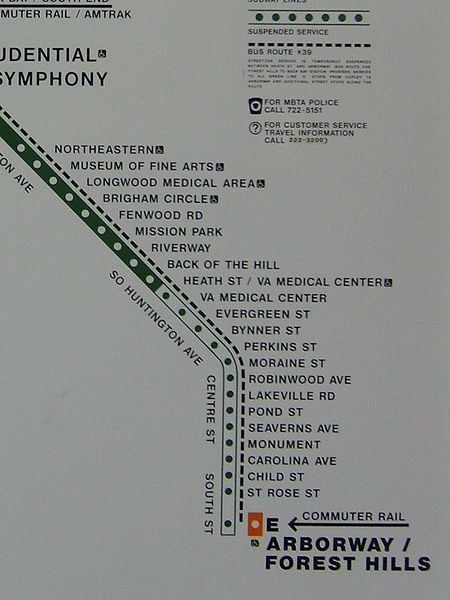
So I'm guessing many of you are probably thinking right now, "Those maps really weren't lying... the T did actually go there!".

So yes, the E branch did, at one time, terminate at Arborway/ Forest Hills station. Just as a quick note, to experience this line first hand Aaron and I, on our last night of our freshman year, took the Orange Line to Forest Hills and walked the now defunct street car line all the way to Heath Street (where the E branch currently terminates).

A map at Park Street Showing
the suspended service
Now onto the history! Streetcar service began on the Arborway line in the early 19th century. Jamaica Plain was one of the first suburban regions in America that had streetcar service to a major downtown. The line which ran along South Huntington, Centre St. and South St. was an integral part of Boston's streetcar network for about a century.

On December 27, 1985 the MBTA "temporarily" suspended E branch service in order to execute two construction projects along Huntington Ave. In one project, the City of Boston rebuilt part of Huntington Ave east of Brigham Circle, where the LRV's run on the street with the cars. The second project was to rebuild the portal (where the street cars enter the subway) to allow for the then new and heavier Type 7 LRV's to run on the E branch.  While the branch was suspended its service was picked up by a bus line that went from Copley Square to Forest Hills.

An old catenary pole on South St.
In 1986 service was restored to the inner part of the line but terminated at Brigham Circle. Then three years later streetcar service was restored but only to the current terminus of Heath Street. This section is the only remaining section of street-running tracks in regular use by the MBTA. The section of the line from Heath St. to Arborway, to this day, has yet to be restored. 


The paved over tracks leaving going
Inbound from Arborway
Today, in effect, the MBTA has phased out the Arborway Line between Heath St. and Forest Hill's. Although it is still officially "temporarily" suspended, the perception that the line has forever closed has gradually strengthened. There was some hope for the defunct line during the Big Dig, but, like many things that were linked to the  Big Dig, nothing ever came of it. The T was supposed to restore service to this section in order to comply with the Clean Air Act which is required by the Environmental Protection Agency. They were to eliminate the #39 bus and restore electric streetcar service. This has still yet to happen! 


Although the presence of the old catenary poles shows that the line did once exist, today, it is really hard to picture LRV's rolling down South and Centre Streets. As Aaron and I walked through this very cultural and tight knit section of Jamaica Plain, it seems that this neighborhood is still thriving even though there is only a bus serving the area. I do know for a fact though that if streetcar service was restored to this area it would be thriving even more! The culture of this area is unbelievable and should be seen by everyone, but is hard for people to find because it is only accessible by bus. 


Well folks thats this months history lesson! I really hope you enjoyed it and I hope you go out to JP and experience the great restaurants and stores! Check out Ten Tables and The Real Deal Deli! 

If you have any suggestions for next month leave a comment!

Saturday, April 30, 2011

YAY History: The "EL"

In this months history post I am going to be covering the history of the, now defunct, Orange line Elevated or the "EL".


MBTA map that shows the 
Elevated
The first phase of the "EL" , which was opened in 1901, was dubbed the Charlestown Elevated. The line ran from Everett right through Charlestown and then descended underground at North Station. The line then ran underground through downtown (todays Orange Line Subway) and then once again came above ground to meet the Washington Street Elevated. The Washington St. Elevated ran from the Chinatown station (then Essex st.) and terminated at Dudley Station. In 1909 the Elevated was then extended to Forest Hills. 


During the 1970's the MBTA was experiencing a time of growth. They began to examined many of their lines and fund improvement and revitalization projects. The Orange Line Elevated was the first on their list. The MBTA first thought of ways that they could extend the Orange Line. They proposed extending the northern terminus to Route-128 in Reading, then extend southern terminus to Dedham. As a result of this review the MBTA decided they were going to rip down the Charlestown Elevated. 

The MBTA built a brand new route for the Charlestown line. The new line ran from A new underground station at North Station through an underwater tunnel under the Charles River. The line then traveled at grade along newly acquired track from the Boston and Maine Railroad right of way under I-93. The line  then terminated at the present day terminus of Oak Grove.


Riding over the Charlestown Bridge
It wasn't long after the closure of the Charlestown Elevated that the MBTA came up with the idea to try and re-rout the rest of the elevated Orange Line. 

During the early 1980s, although the Orange line had become the most reliable and most ridden rapid transit line in Boston, it had become the most unsafe line in the system, due to the amount of crime on trains and at stations. 


The once beautiful victorian style elevated stations were now in horrible despair and were in need of a major refurbishment or total demolition. Although it was going to come at a huge price tag, around $730 Million, $1,677,050,744 in today's money, the MBTA was going to re-route the entire southern half of the Orange Line and rip down the Washington St. Elevated. In May, 1987 the last revenue trip was performed on the Washington St. Elevated. Thereafter the Orange line, instead of rising to the elevated tracks on Washington St., would veer west to follow the Mass Pike on the acquired right of way from the Boston and Albany Railroad and then travel along a newly constructed right of way all the way to Forest Hills. This became the Orange line that many of us ride today. 
North Station Elevated


As with many high profile and expensive projects, there was much controversy that came with the closing of the elevated. Although the line terminated basically in the same place, the new route largely bypassed Washington St. The MBTA promised replacement service to local residents who relied on the Elevated to get to work. A green line extension that would run from Washington Street to Dudley Square, then divert southeast on Warren Street towards Dorchester was proposed, but dropped soon after. It took the T until 2002 to implement some sort of service replacement for this area, being phase 1 of the Silver Line.

Wednesday, March 30, 2011

The Architecture of Charles Bulfinch

Charles Bulfinch
Image from NNDB.com
Few people have left as great a mark on the architectural landscape of Boston as Charles Bulfinch has. Thought by some to be the first native-born major American architect, Bulfinch helped to singlehandedly shape the face of the city and its buildings in the late 1790s and early 1800s.


Born in 1763, he attended the Boston Latin School and later went on to study at Harvard College. While on a tour in Europe, Bulfinch was struck by the design of planned urban areas in France, inspiring him to become an architect. When he returned to the States, he began his career first by designing mansions and residences in and around Beacon Hill, later moving on to the larger structures for which he is most famous for. 


He took his interest in urban planning back to Boston as well, creating innovative housing complexes and other real estate developments. One such development was called Tontine Crescent, a set of sixteen interconnected townhouses on Franklin Street, the first of its kind in the city. Soon after, he built a similar development called Colonnade Row, named for the Doric Colonnade it had on it, on Tremont Street overlooking the Common. 


Bulfinch's buildings follow the Federal style of design, built with red bricks, simple angles, and having arches as a common feature. By taking a stroll through Beacon Hill on any given day, almost all the buildings one would see would be in the Federal style. Many of the buildings he designed helped propel him into fame. He built many churches, including the Hollis Street Church, the first Catholic church in Boston. 


Although most of the buildings Bulfinch built are no longer around, a good few remain standing today and still play important roles in the life of the city. Some are still actively used for their original purposes, while some have been turned into museums and historical sites. Read on for an exploration into some of the great buildings that Charles Bulfinch created.


Massachusetts State House
Bulfinch is probably most famous for his design of the Massachusetts State House. (He also built the Connecticut State House in Hartford.) In 1795, the (then) town of Boston purchased the pastureland of John Hancock, who died two years earlier, for the site of the state house. In 1797 construction was finished, although Bulfinch had begun designs for this project as early as 1787. The distinctive golden dome that has become a trademark for the city is sheathed in copper and covered in 23-karat gold, but it was originally made of wooden shingles.


First Harrison Gray Otis House - 141 Cambridge Street, Boston


This house was completed in 1796 for Harrison Gray Otis, a lawyer, real estate investor, and prominent politician of the time. He was a US Senator from 1817 to 1822, and also held many other offices throughout his life. The house has been designated as a US National Historic Landmark and is currently owned by the Historic New England organization.


Second Otis House - 85 Mount Vernon Street, Boston


Bulfinch built a total of three houses for Harrison Gray Otis and this is the second one. It is currently listed on the National Register. Otis lived here until 1806, when he moved into the third house designed by Bulfinch, located on nearby Beacon Street. 


Third Otis House - 45 Beacon Street, Boston 


This house was completed in 1806 and is the largest of the three. Otis resided here until his death in 1848. The structure was originally freestanding, yet is now surrounded by other buildings on both sides. The house is currently home to the American Meteorological Society.


87 Mount Vernon Street

#87 is on the right.


This house was built in 1805 and for a time was home to General Charles J. Paine, a Civil War general and yachtsman. At present, the Colonial Society of Massachusetts calls this building home. 


Faneuil Hall Expansion


Boston wouldn't be Boston without Faneuil Hall. This iconic Boston landmark has been an active marketplace and meeting hall since 1742. It gains its name from Peter Faneuil, a wealthy merchant who provided funding for its construction. Faneuil Hall played a huge role in Boston's political life in the Colonial Era, serving as a meeting place and forum for all political matters. 


In 1806, Bulfinch was charged with designing and building the expansion of the hall, making it wider and adding a third floor. Today, it is still used for city debates and has become Faneuil Hall Marketplace. It is designated as a National Historic Landmark.


St. Stephen's Church (New North Church)


Located in the North End, St. Stephen's is the last remaining Bulfinch church in Boston, dedicated in 1804. It was originally built for a Congregational group, but in 1813, it became a Unitarian church. In 1862, it again changed hands when it was sold to Bishop Fitzpatrick and became St. Stephen's, a Roman Catholic church, reflecting the large amount of Irish immigrants settling in Boston. 
Related Posts Plugin for WordPress, Blogger...