Showing posts with label green line. Show all posts

Wednesday, September 25, 2013

Green Line "Next Train" Signs: How They Work

Inside the MBTA Operations Control Center  (OCC)            Courtesy: MBTA


With last weeks unveiling of the MBTA's new "Next Train" signs for the Green Line, some of you might be wondering why does the Green Line still not have real time arrival data?

Map of AVI locations       Courtesy: MIT
Although these new "Next Train" signs are new to the Green Line, the technology that they run on has been around for the past two decades. AVI or automated vehicle indicators are how the Green Line is currently tracked by MBTA employees. 

Around the system there are a series of AVI readers embedded in the tracks. When a train passes over one of these readers it reports the trains location to the T's Operations Control Center (OCC) which is located at 45 High St in Boston. When a train passes a specific point it's number appears next to that AVI point on a large map at OCC. This means the T knows that a specific train is at or beyond that specific point. When it reaches the next reader it will disappear from the first point and appear on the next one.

Seems like the T should know where most Green Line trains are right? Unfortunately, it's not that easy. In the central subway, which runs between North Station and Copley Station, the AVI points are somewhat close to one another. When the trains go above ground however, the points are very far apart. All above ground routes are monitored by an actual human being. An MBTA inspector will post themselves at a certain stop along the line and monitor when trains are passing by.
    
Still a little confused? Here's an example: Lets say Green Line train 3651, which has a destination of Boston College, just passed the AVI point at Copley station. The T knows that the train is at or beyond Copley but it has not yet passed the next point which is at Kenmore Station. Once the that train passes Kenmore the next AVI point isn't until Chestnut Hill Ave. which is 16 stops from Kenmore. On average, that's about a 25 min ride over 3.5 miles. During that time central control has no visual on that train unless the inspector on the line physically reports its position. 

Overall, the T knows what train will be next (B,C,D,E) but they do not know the spacing between trains. Therefore no real time train data can be determined for the Green Line. These new "Next Train" signs are a big step for the Green Line but bigger and better things are coming. Back in January the MBTA announced that they would have real time tracking data for the Green Line by 2015. Since it's still over a year away, these "next train" signs will have to do for now. 


Friday, March 22, 2013

What really causes MBTA delays?

     Delays are a regular occurrence on the MBTA, especially during the winter months. You might read online or get an alert on your phone that your train or line is experiencing delays due to a mechanical failure, medical emergency, or signal problem but what does the MBTA actually mean when they use these terms? 

Here is Boston to a T's list of MBTA "Delay Terms" and our interpreted definitions. 


Mechanical failures
    
      A mechanical failure can include any failures related to locomotion, braking (traction, pneumatic) and electricity. Due to the fact that commuter rail operation is such a dynamic system involving multiple systems working together, many issues can constitute a mechanical failure.  Engine failure can relate to either the main driver engine which powers the locomotive or to the Head End Power (H.E.P.) generator which generates all of the electricity & power for the train set. Mechanical failures happen all to often, this is due to the age of the MBTA's locomotive fleet (the majority of which are over 30 years old).

Disabled Train
   
     A train can become "disabled" due to a number of different problems. The trains AC or DC traction motors and propulsion system may blow out and prevent the train from moving, the braking system may not be working properly, there may be an electrical problem, or a computer fault. Any number of "mechanical failures" will cause a train to be "disabled". 
    
Signal Problem 

    One of the most common reasons for a signal problem is the interruption of a circuit between a signal and the signal's relay. This would cause all signals within an area (or block) to go to red. This will result in any train within the block to have to stop (and of course all trains behind it) until the prblem can be resolved. Sometimes it will reset on its own, other times signal personnel have to go to the signal, and check all the signals in the area to see where the prioblem started and then correct it. This takes time, and thus causes delays. Signal problems can occur all over the MBTA system. There are a few lines, however, that these delays are much more common. Due to the age of it's signal system the Fithcburg line is constantly plagued by delays. There are however plans in place to fully upgrade that system.

Speed Restriction


A heat kink on the WMATA
Photo: WMATA
     Speed restrictions can be put into place on an area of rail due to a large amount of reasons. One of the most common is heat restrictions. In the past CSX (the freight rail company that once owned most of the Worcester line) would implement a speed restriction on the Worcester line when temperatures would reach about 90F. Steel rails slowly expand and contract as temperatures rise and fall. In fact, an 1800-foot length of rail will expand almost one foot with an 80-degree change in temperature.With welded rail the normal tendency to expand must be constrained internally by securing the rail. Engineering measures, including heating the rail, are taken when rail is installed to account for rail expansion and contraction. The ties, rock ballast, and rail anchors must be strong enough to keep the rail solidly in place instead of expanding or contracting. Under extreme heat, the rail, on rare occasions, wins the expansion battle and a heat kink occurs. A heat kink causes the track to shift laterally causing a curve in what is otherwise a straight pair of rails.Speed restrictions can also be caused by construction, signal problems, and medical emergencies.

Medical Emergency

     Although medical emergencies are somewhat self explanatory, there are still a few different things that can cause one to be put into place. Someone can be physically sick or hurt on a train and need the assistance of an ambulance. This causes the train to move to the nearest station and standby until medical personnel and transit police can arrive. The train will not be released until the scene is cleared. Another cause can be a trespasser being struck by a train. Accidents like this will cause major delays on that rail line. There will be extensive police activity, and speed restrictions will be put into place if other trains are able to pass the scene. 
A fire at Chinatown Station in 2012

 Police / Fire Department Activity 


     Police and Fire department activity is a delay that happens anytime the police or fire departments need to be called to an MBTA train, station, or other property. It could be because of an unruly passenger, an electrical fire in a station, or a person jumping into the subway pit. 

Amtrak Interference (Providence/Stoughton/Lowell/Haverhill)

     This delay is just as it states. Trains are delayed due to an interference with an Amtrak train. Usually these delays happen on the Northeast Corridor (which Amtrak owns and therefore has priority over MBTA trains). If an Amtrak train is late it will then cause the trains that follow it to be late. This can also happen on the Lowell and Haverhill lines where 
Amtrak's Downeaster runs. 

Freight Interference (Fitchburg/Worcester)


     Once again this is just as it states. Trains are delayed due to an interference with a freight train. Usually these delays happen on the Fitchburg and Framingham/Worcester Lines. CSX and PanAm Railways are the prime culprits, in this area, when it comes to freight interference. 


Downed Wire

MBTA Type-8 LRV pantograph and catenary. 

     A downed wire can cause MAJOR delays on the railroad. Currently only the Green Line, part of the Blue Line and the entire Northeast Corridor have over head electric wire. Over head electric wire, or catenary,  is a system of overhead wires used to supply electricity to a locomotivestreetcar, or light rail vehicle which is equipped with a pantograph. Non-electric trains (such as the MBTA's diesel locomotives) may pass along these tracks without affecting the catenary. Downed catenary wires can be caused by tree limbs falling over, high winds, and broken support brackets. 


Friday, November 30, 2012

Government Center Station to get full rebuild during 2 year closure

Courtesy: MBTA
The MBTA's Government Center station will soon get a much needed modernization. The MBTA has announced that starting in September of 2013 they will be closing the station to the riding public for a total of two years. The $90 million project is set to completely modernize the station and also rebuild parts of City Hall Plaza.

The renovation will replace the relic station entrance that looks more like a bunker than a station head house. In addition to the new head house, the Green Line and Blue Line platforms will be reconstructed, new escalators and elevators will be installed, and the stations fare collection area will be expanded. An overhaul of the stations electrical and lighting system will also take place.

Government Center station (then Scollay Square station) was opened in to Green Line customers in 1898 and Blue Line customers in 1916, it has the distinction of being the second oldest station in the MBTA's system. The station has not seen a reconstruction since it was re-named "Government Center" about 50 years ago.

Current Station entrance
Uploaded by Flickr user: Kingdafy
The project will also bring the station up to ADA compliancy. Currently Government Center station is one of six stations in the subway system that are not handicap accessible.

The 24 month closure is said to be saving the T over $16 million and shaving over a year off the construction process.

One large problem for the 21,000 commuters that use this station per day is going to be finding another station to use during the construction. Fortunately, the T will be running a special bus shuttle that will run between Government center, Haymarket, and State street stations. MBTA spokesperson, Joe Pesaturo, also said that Bowdoin station, normally closed on nights and weekends, will be open for passengers later on weeknights and on weekends. This will only be on a trial basis however. 


Courtesy: MBTA 
MBTA officials are are set to hold a public hearing about the construction project and station closure on December 12th from 5:30 - 7:00pm. The hearing will be held at 100 Cambridge street in conference rooms B, C, and D which are located on the second floor. 


Federal funding is said to offset about 80% of the costs associated with this $90 million project. 

Monday, October 22, 2012

First MBTA LRV arrives for re-build

Type-7 #3660
at the Riverside car house.
Last June, Scott Page, a Boston to a T Guest Contributor, reported that the MBTA had approved the overhaul of 86 Green Line Type-7 Light Rail Vehicles (LRVs). The vehicles are set to be overhauled by Alstom Transportation which has a facility in Hornell, New York.

Four months later, the overhaul program is finally starting to move forward.

Two weeks ago, the first of the 86 cars (LRV #3614) left the MBTA's Riverside yard on a flatbed trailer and headed up to Alstom. This first car, the "pilot car" will take a little over a year to overhaul. Pilot cars usually take the longest to overhaul due to fact that it is the first time the contractors are working on the equipment. If the contract continues on its original schedule, the pilot car should be returning to Boston by November 7th of next year. If all goes well with the pilot car, sets of cars will then be sent up to Alstom on a rotating basis.

The 86 Type-7 LRV's that are being overhauled were built by the Kinki-Sharyo company of Japan between 1986-87. They have been the true powerhouse's behind the Green Line for the past 25 years. They have averaged almost 1 Million in-service miles since they began running on the rails in Boston.

The vehicles are now showing significant signs of age however. Although these vehicles are still more reliable than their Type-8 counterparts it is time for them to get some significant upgrades.

Here is a breakdown of what kind of work will be done to the vehicles during their overhaul.


Work Done
Equipment
Full replacement with upgraded design
HVAC system, Low Voltage Power Supply, Aux. Lighting, Cab Equipment, & Door Indicators  
Replacement - in-kind
Flooring, Seating, Vehicle Insulation
Overhualed
Vehicle Structure, Roof, Exterior Skin, Door Systems, Braking Equipment, Trucks, Propulsion, Pantograph, and Interior. 


Body damage on a Green Line Type-7 LRV
All 86 cars will come back to Boston with a brand new paint job similar to the "Olive Green" color that the T has been painting some of the LRV's in recent years.

The re-build is said to last until 2015 but some cars should be back in active service by early 2014.

This overhaul is part of a $104 Million contract that the T has with Alstom. The project is said to create around 200 new jobs for the company. Alstom will also soon be starting the overhaul of the MBTA's 74 Kawasaki bi-level coaches. No timeline has been set up for that project yet.


Tuesday, October 9, 2012

MBTA Green Line train derails at Brigham Circle

All photos courtesy of Scott Page
Human error has been detrermined to be the cause of an MBTA green line derailment at Brigham Circle.

Yesterday at around 4:00 pm, MBTA Type-7 LRV #3633 derailed at the crossover at Brigham Circle station.

#3633 struck it's sister car Type-7 LRV #3634 which was sitting on the opposite track. The trains sustained minor damage during the accident. #3633 has some minor body damage (missing panels) and also sustained damage to it's center truck and articulation. #3634 also had some minor body damage. Also during the derailment, a light pole was bent over and a catenary wire bracket was broken off the line.

Most news outlets here in Boston are reporting only one form of human error was to blame in this situation. I believe, however, that there are three different ways people are at fault.

1: The Inspector at Brigham Circle Station

     -When Green Line trains terminate at Brigham Circle (which is all weekends and sometimes during the week) the inspector at Brigham must switch over the tracks so the trains can cross over and switch back outbound and return to the central subway. Today that did not happen. The inspector at the station failed to switch the track back over and subsequently the train derailed, thankfully only causing minor damage and not many injuries. I must however give the inspector a break. An MBTA press release stated that the inspector is an 18-year veteran of the MBTA who has had no prior major incidents.

2: The operator of #3633
   
     -Every operator that is trained to drive a trolley on the Green Line is taught to read their rail (make sure the switch they will be passing over is in the right direction) at every crossing and switch throughout the system. This however was not done today. If the operator had been paying attention to the rail in front of them, they would have noticed that the switch was not set properly and the accident would have been prevented.

3: The Administration/Inspector
   
     -According to the MBTA website, the schedule for the Green Line 'E' branch on Columbus day was the same as a Saturday schedule. The only exception was that trains would terminate at Heath Street instead of Brigham Circle like a regular weekend. Today that did not happen. If 'E' line trains were terminating at Heath St. this incident would have been avoided all together. This can however be blamed on a headway adjustment, meaning that the inspector at Brigham stopped the train before Heath because there were not enough Lechmere trains in the central subway (Which is done on a regular basis during the week).

Overall, this accident was not the fault of just one person and hopefully it was a learning experience for everyone involved.

After the incident, it took MBTA personnel six hours to get the trolley back on the tracks. #3633 and #3634 were then moved to an MBTA maintenance facility for evaluation and repair.

Monday, July 30, 2012

Guest Post: Automatic Stop Announcements, Tracking, & More On The Green Line


Green Line Trolley at BU Central 
     “Entering: Park Street. Change here for the red and orange lines. Doors will open on both sides.” We’ve all heard Frank Oglesby’s mellifluous voice bellowed throughout the interiors of countless green line trolleys. But how does Frank know when to speak up? Or, for the matter, what to say? Surely he can’t just be guessing; he’s far too accurate for that to be the case. So how does he do it? It all has to do with something called Automatic Station Identification or ASI for short. Here’s how it works:
Located approximately 50 meters apart, the green line (similar to the red and blue) has “tags” imbedded in the tracks before, after, and at each station. By themselves, these tags do nothing; they merely have a unique number programmed into them, but require no battery or external power source. Each green line trolley, however, is equipped with a device that actively “reads” the tracks in search of these tags using microwave radio frequencies. When a trolley passes over a tag, the tag number is then communicated to the onboard message system and matched with the appropriate audio and visual messages. At that point, our good friend Frank announces that we are indeed entering Park Street and that one can transfer to the red and orange lines here after exiting the train from either side. With each announcement, the displays also change to reflect what is being said.
While this type of system does work (usually), the one used by the green line is quite dated and therefore its capabilities are rather limited. For example, at the start of each trip the operator must manually enter the trolley’s destination. This not only ensures that the proper audio and visual messages are being communicated to the passengers, but also ensures that the proper track configuration is being used in the tunnels for that specific trip. What’s that mean? It means that, utilizing a system called Automatic Vehicle Identification (AVI), the tracks will automatically align to get your D line trolley to Riverside—not Boston College, Cleveland Circle, or Heath Street—and so on.
Green Line tracks at Chestnut Hill
Another, more major limitation of this system is the fact that most of the information communicated between the track equipment and trolleys is not currently capable of being transmitted back to the MBTA’s Control Center, located at 45 High Street in Boston. This means that not even the T has a good idea of exactly where the next outbound B line (or any) trolley is and when it will be arriving. The only information automatically communicated back to the Control Center is when a trolley has just passed through one of a handful of junctions located throughout the underground portion of the green line. This, however, does not specify the destination of the trolley but merely which direction it is headed (inbound or outbound) giving the MBTA only a very vague idea of where its trolleys are at any given time. Because of this, riders won’t be seeing tracking available on the green line until the MBTA has come up with a way to locate the trolleys themselves.
Aside from its limitations though, the current system does help the MBTA fulfill its federally-mandated ADA requirement for consistent stop announcements and lets commuters and tourists alike know exactly where they’re headed. Here’s to Mr. Oglesby continuing to help passengers find their way for many more years to come.

Learn more about Michal in our new Guest Contributors section!

Pictures copyright © 2012 Michal Skrzypek


Monday, June 18, 2012

Guest Post: Green Line Trolleys Get New Lease on Life

Here is another great guest post by Scott Page! You can follow him on twitter : @ScottridestheT

MBTA Board of Directors Approves Overhaul of Type 7 Cars

      Identified by their spacious interiors, passenger friendly seating arrangement, and faux wood grain panels the Type 7 light rail vehicles have been the workhorse of the MBTA’s Green Line for the past two decades. The first one hundred cars, built by Japanese manufacturer Kinki-Sharyo, quietly entered service between 1986 and 1987 with an additional order of twenty cars arriving in 1997. The Type 7s have been solid performers since the day they arrived and have single-handedly saved the Green Line from meltdown twice in their service life – the first time upon their arrival in 1986 and for the second time around the turn of the millennium. The cars, now entering their 26th year of service, recently received the approval of the MBTA’s board of directors to receive a mid-life overhaul expected to extend the life of the trolleys for decades to come.
The $104 million contract with Alstom Transportation Inc of New York calls for the overhaul of the 86 active Type 7 cars from the 1986 order. The contract also carries a provision which allows for the MBTA to overhaul the twenty cars from 1997, which are currently too young for a rebuild, at a later date.
The early 80s were a difficult period for the Green Line. The last of the PCC trolley cars from the 1940s had fallen into disrepair and a fleet of light rail vehicles built by Boeing in the mid-70s were plagued with an assortment of mechanical problems. Car shortages became a frequent service disruption. The arrival of the Type 7s allowed for the retirement of the last PCC cars – with the exception of the small fleet of fully restored cars which still serves the Mattapan-Ashmont High Speed Line – and provided enough cars for the Green Line to meet its requirements regardless of how the temperamental Boeings were performing.


      In the late-90s the MBTA attempted to make the Green Line ADA compliant by introducing a new fleet of 100 Type 8 cars from Italian manufacturer Breda. The cars, which feature a low-floor center for the elderly and handicapped, were intended to replace the last of the aging Boeings and work alongside the Type 7s. But instead of ushering the Green Line into a new era of user friendly service the Type 8s arrived with a thud – literally. 


Plagued by derailments, propulsion and braking problems, and an inability to successfully trainline with existing equipment the Type 8s slowly trickled into service throughout the 2000s – being pulled from service briefly in 2002 – with the last car entering service in 2007. 
As the Type 8s entered service at a molasses-like pace the Boeing fleet dwindled in size and ability. By the time the cars were pulled from service in 2007 they were only capable of doing one to two trips per day. While the Type 8s floundered and the Boeings dropped out of service the Type 7s served as the backbone of the line moving people into and out of the City of Boston. 
After 26 years of remarkable service the cars deserve the TLC and pampering they’re about to receive to ensure they provide quality service for the next two decades.

Tuesday, April 17, 2012

Guest Post: Green Line Operators Show Their Worth


Here is a another great guest post by fellow transit enthusiast Scott Page.
 You can follow Scott on Twitter : (@ScottridestheT)! 

When the system fails – labor shines.


As the evening rush hour began on Thursday April 12th a suspicious unattended brief case was reported at Boylston Station on the Green Line. At first trains were ordered to bypass the busy downtown station but as the Boston Police arrived they ordered all trains halted between Government Center and Kenmore effectively rendering the Green Line inoperable. 
The Trailer Person in 3850 walks the car keeping
passengers abreast of the situation
As police investigated the package at Boylston trains backed up at stations along the line. At Park Street thousands of riders, all eager to get home, were greeted with the same expressionless automated message: “Attention Green Line passengers. Due to a police investigation at Boylston all Green Line service is suspended between Government Center and Kenmore. Please seek alternative service”. The cold inhumane voice of the automated message only served to confuse riders as it offered no information and could not answer questions. But the displaced Green Line riders were privy to one big advantage – appropriate transit staffing. At the westbound platform of Park Street Station sat four two-car trains awaiting further instruction – meaning eight operators were available to assist the riding public in addition to the three Green Line officials on the platform. 
No crew handled the riding public better than the Pilot and Trailer Person of the E Heath Street train waiting on the fence track. From their positions in cars 3626 and 3850 they stayed in constant communication with central control and answered passenger questions to the best of their ability, with the Trailer Person in car 3850 walking the length of her train to individually answer riders’ questions. 
In recent years the MBTA has made a strong push towards the irresponsible and regressive operative style of One Person Train Operation on its Rapid Transit lines as an alleged cost savings measure. The Green Line, which currently has no plans of converting to one operator, is the last line in Boston to use a multiple person crew. Green Line streetcars, for the record, require one operator per car for on board fare collection above ground and to open and close doors as the cars cannot trainline door control. 
But as history tends to repeat itself it most likely won’t be long until MassDOT and the MBTA announce plans to strip the Green Line of its appropriate staffing levels. That is why it is imperative to take note of situations like the one yesterday to show the importance of second operators. The smooth handling of thousands of riders at the beginning of the evening rush hour and the start of a rush for a Bruins playoff game is a testament to the hard work and importance of all MBTA Streetcar Motorpersons regardless of which position they are in – Pilot or Trailer Person.

Monday, April 9, 2012

MBTA April Service Changes

This month is going to be a very busy one in regards to MBTA service changes and diversions. Here is what you need to know for the month of April!

Marathon Monday

Green Line LRV's line the entire platform at the
Hynes stop last year on Marathon Monday
This year Marathon Monday falls on April 16, 2012 (one week from today). The city will be packed as people from across the world show up to watch the race. With more people in the city the demand for public transportation is increased. This means that the MBTA must make some changes. 

Subway:
  • The Red, Blue, Orange, Green, and Mattapan HS Lines will all operate on their  regular weekday schedule and there will be extra service provided on all lines before and after the marathon. 
  • Copley Station will be CLOSED all day. Customers wanting to get to the Marathon will have to use Hynes Convention Center station or Arlington Station. Passengers will only be able to exit from the Boylston Street side of Hynes Convention Center Station. 
  • Word of Advice: If you don't have an MBTA Link-Pass make sure you add value to your Charlie Card before Marathon Monday. Lines will become very long at Charlie vending machines
Commuter Rail:
  • MBCR Commuter rail service will operate on its regular weekday schedule. 
Bus:
  • Buses and trackless trolleys will operate on a Saturday schedule.
  • Route 55 - Queensbury/Copley Station - Service will be terminated until completion of the Boston Marathon. 
  •  Buses will be rerouted at certain times during the day to prevent disruption of the race. These routes include: Southside Routes: 1, 8, 9, 10, 39, 47, 52, 57, 59, 60, 65, 66, 86, 504. Northside Routes:  86, 62, 76, 77, 80, 350, 94, 95, 96, 134, 101.
The MBTA expects that with the the dramatically increased ridership and extreme crowds on Marathon Monday passengers should expect on different parts of the system through out the day. (Especially Commuter Rail and the Green Line) Make sure you check MBTA.com or follow @MBTA_Alerts for down to the second service alerts! 


Weekend Red Line Diversion


During the weekend  of April 28-29th bus shuttles will replace Red Line trains between Boradway Station and Kendal/MIT Station. 
  • Shuttle buses will stop at Broadway, South Station, Park St., Charles/MGH, and Kendall/MIT. 
  • Buses will NOT stop at Downtown Crossing Station. For passengers looking for service to DTX you can transfer at Park St. and walk through the Winter St. Concourse to the Orange Line at Downtown.
The diversion is due to the continued work on the Park St. elevator project. The MBTA must run a power supply for the new elevator through the Red Line tunnels from South Station to Park St. 


Worcester and Fairmount Commuter Rail Schedule

The MBCR put new schedules into place for the Worcester and Fairmount Commuter Rail Lines. The revised Worcester commuter rail schedule is due to the reconstruction of Yawkey Station. The revised Fairmount commuter rail schedule is due to necessary commuter rail maintenance. 
  • The new Worcester Schedule is available HERE
  • The new Fairmount Schedule is available HERE

Monday, July 4, 2011

Forget the shuttle bus...Lets take a walk!

When I saw this I couldn't help but start laughing!!

So apparently its takes the same amount of time to walk to Science Park as it is to take an MBTA shuttle bus. 

Finally the MBTA has realized that their shuttle bus service dose not run as well as it should!


Monday, June 20, 2011

YAY History: MBTA LRV's

Well everyone, strap into your seats because this history lesson is filled with all kinds of information! Thats right, this month I'll be taking you through the success and failures of the MBTA's acquirement of three different types of Light Rail Vehicles (LRV)

Let's start with a little bit of background information. Starting in 1905 the MBTA or then The MTA, started purchasing trolley cars for their entire system. They also began a numbering scheme that would characterize all new trolleys purchased as "Types". From 1905 until 1922 the MTA purchased around 946 "Type" cars that ran from Type 1's right through Type 5's. When the company was looking for a replacement of their type cars, they chose, like many other cities did, the Presidential Conference Committee (PCC) street car. They did not opt to call these their Type 6 cars though. In August of 1964 the MBTA acquired the MTA and took full control of all bus, trolley, commuter rail, and subway service. At this time they also introduced the T logo and advertising campaign that we recognize today.
"Type 6" Mockup! 

At about the same time as the formation and take over of the MBTA, engineers working for the Authority began designing a replacement for their World War II era PCC street cars. The design was given the designation "Type 6" resuming the MTA's original numbering scheme. The engineers created a wooden mock-up of one end of the proposed Type 6 at their Everett shops in 1968. The purpose of this mock-up was to allow designers, operating personnel, and the public to judge the designs, layout, and comfort on a full scale. The actual mock-up still exists and it is currently on display at the Seashore Trolly Museum! Unfortunately nothing ever came from this mock-up. The design was solicited out to a few companies but was rejected by the T because all of the bids were to high.

An ad thanking Boston for choosing Boeing!
Notice it says next stop Cleveland.
Cleveland opted not to make a contract with Boeing
At the same time however, the San Francisco Municipal Railway (MUNI) was also looking into designing new cars to replace their aging streetcar fleets. The United States Urban Mass Transit Administration (UMTA) and the Federal Funding Agency mandated that MUNI and the MBTA work together in a joint design for a new type of street car. This would eventually be dubbed the Standard Light Rail Vehicle (SLRV).

By 1973, the UMTA awarded the building contract to the Boeing-Vertol company of Philadelphia at a cost of $300,000 per car. Initially MUNI ordered 80 cars and the MBTA ordered 150. Later though, the orders were increased to 100 and 175 respectively  It took until 1975 for demonstrator models to be sent to both cities. After they proved to operate successfully, the MBTA then put them into full revenue service by 1976 on the "D" Riverside Branch of the Green Line.

Right after the LRV's entered revenue service, however, they proved to be very troublesome. They were prone to numerous problems such as derailments on the tight curves of the nearly 100 year old MBTA subway, shortening out of electrical systems, premature failure in the cars' motors and propulsion systems, the overly complex plug doors not operating properly, and much more.


MBTA LRV #3424 at the Seashore Trolly Museum
This has the Bi-fold doors and the A/C units!
In Boston, the LRV situation was becoming a major political and public relations nightmare. The MBTA was still accepting new cars from Boeing-Vertol, but the cars were falling out of service faster than the MBTA's maintenance staff could repair them. Additionally, the MBTA could not acquire replacement parts fast enough to repair the disabled LRV's. In an effort to keep as many LRV's operating as possible, MBTA maintenance crews began cannibalizing some of the disabled cars for replacement parts. To help prevent the riding public from seeing the sheer number of brand-new, but heavily cannibalized LRVs, several of the cars were hidden around the system where the public was not likely to find them. The Boston Globe released an article about the cannibalized and hidden LRVs, becoming the first time the issues with these vehicles came into public view. 


In 1979, the MBTA successfully sued Boeing-Vertol for financial damages, the cost of repairs and modifications to several cars, and the ability to reject the delivery of the last 40 cars of their 175 car order. The T also put into place a PCC rebuilding program in order for them to keep a functional fleet of street cars on the Green Line. Since the T ended their contract with Boeing, they now had the ability to do absolutely anything they wanted to do with the cars. One of the first things they did was add air-conditioning units to the top of the cars. The original cooling systems were a forced air system that were mounted on the bottom of the cars and were problematic because they sucked in dirt from the tracks (one of the many reasons why an airplane manufacturing company should not be designing and manufacturing trains and trolleys). The T also replace the troublesome and complicated plug doors with bi-fold doors that we see today. 


The CLRV 4027 sitting at the Riverside car house in 1980
So it is now 1980, and the MBTA is now looking to design a trolley that might actually be useful on the Green line and might not be a money pit. During the first steps of this process the MBTA looked to Canada for assistance. The T began leasing three Canadian Light Rail Vehicles (CLRV) from the Toronto Transit Commission. For about 90 days the T operated, maintained, and evaluated their performance on the Green Line. The T thought that maybe they would find luck in making another joint venture. These cars were very different from the Boeing LRVs. The CLRVs had no articulation in the center of the car, they did not have a pantograph and instead had a whip like the PCCs, and they also did not have doors on the left side of the train. One of the largest differences though, was that they did not have cabs at both ends of the trolly. All in all the MBTA ended up passing on the CLRV design and decided to create a brand new design on their own. 


Repainted Type 7 at
Reservoir Yard!
Next came the Type 7 LRV. To me the Type 7's are a hybrid car. The T took aspects of many different cars and put them all together. They have the looks of the CLRV and the Type 6 prototype, they have articulation and pantographs like the Boeings, and they have foot-petal control like the PCCs. The overall design was sent to the Kinki-Sharyo company out of Osaka Japan in 1986 and the first of the 100 ordered started arriving in Boston in 1987. After the T found them to be extremely reliable and a good addition to their fleet, they decided to order another set of 20 cars in 1997. The T retired every Boeing LRV by 2007. 


Soon after the MBTA received their last order of Type 7s from Kinki, they were already looking into designing and purchasing their Type 8 cars. 


The T purchased 100 low-floor cars (these unlike the Beoings and Type 7's would comply with ADA requirements). from the Italian train manufacturer AnsaldoBreda (Breda). Right from the beginning these cars were proven problematic and extremely difficult to maintain. The first few cars delivered, in 1999, were failing consistently every 400 miles which was far off from the MBTA standard of 9,000 miles. The cars were also prone to frequent derailments which caused the T to modify a large amount of their trackage around the system at a total cost of over $9 million. In December 2004, the MBTA canceled orders for the remaining cars still to be delivered as part of the authority's nine-year, $225 Million deal with Breda. One year later though, the MBTA announced that they were restructuring the deal and reducing their order to only 85 cars. The last car of the order entered service in Boston in 2006. After the restructured deal with Breda the T was actually receiving a quality product, and this is why in 2007 the T ordered another 10 cars from the company and had them put into service by the end of 2008. 

Tuesday, May 31, 2011

Science Park Station Closed for Six Months During Rehabilitation

Science Park and Lechmere Station on the Green Line will be closed for six months, until December, while the MBTA works on badly needed renovations to rehabilitate the Science Park station. If you've ever ridden through this station, it was probably easy to see that the rehab will be well worth it. Once completed, it will be fully accessible for all riders and will be compliant with the Americans with Disabilities Act. 


Construction began on April 30th and will continue throughout the summer and fall. Improvements will include two new elevators, widened station platforms, replaced platform canopy roofs, and reconstructed stairways. In addition, upgrades to lighting, telecommunications, electrical, fire protection, fire alarm, signage systems, and station landscaping will also be made. 


To make up for the suspended service, the MBTA is now running shuttle buses between North Station and Lechmere, also making stops at the Museum of Science and the Amy Lowell House. During peak hours and special events at the TD Garden, these shuttles will depart every four minutes, on off-peak hours, every ten minutes, and every twelve to fifteen minutes during night hours. 


So why bother closing the station for such a long time? The MBTA cites many reasons: One of the biggest is that it should significantly decrease the time needed for construction—by as much as six months. Much like the proposed Government Center renovation . Other reasons include increased safety for pedestrians and riders, cost reductions by eliminating the need for unnecessary power shutdowns and safety support, and a reduction in nighttime noise because the construction can be carried out during the day time.


For more info, visit the MBTA's Project Page.

Tuesday, May 17, 2011

YAY HISTORY: The E Branch to Arborway

So I'm guessing many of you are probably thinking right now, "Those maps really weren't lying... the T did actually go there!".

So yes, the E branch did, at one time, terminate at Arborway/ Forest Hills station. Just as a quick note, to experience this line first hand Aaron and I, on our last night of our freshman year, took the Orange Line to Forest Hills and walked the now defunct street car line all the way to Heath Street (where the E branch currently terminates).

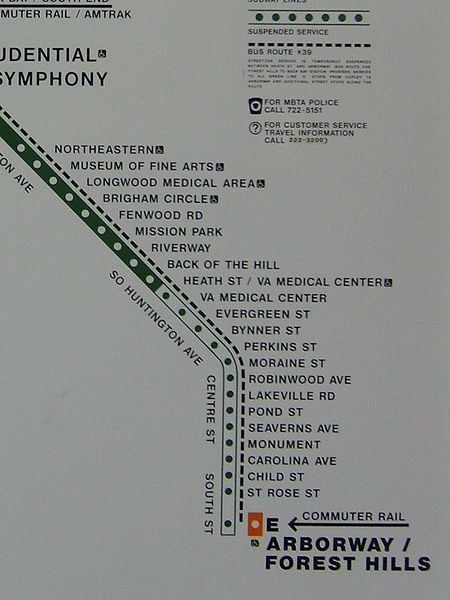
A map at Park Street Showing
the suspended service
Now onto the history! Streetcar service began on the Arborway line in the early 19th century. Jamaica Plain was one of the first suburban regions in America that had streetcar service to a major downtown. The line which ran along South Huntington, Centre St. and South St. was an integral part of Boston's streetcar network for about a century.

On December 27, 1985 the MBTA "temporarily" suspended E branch service in order to execute two construction projects along Huntington Ave. In one project, the City of Boston rebuilt part of Huntington Ave east of Brigham Circle, where the LRV's run on the street with the cars. The second project was to rebuild the portal (where the street cars enter the subway) to allow for the then new and heavier Type 7 LRV's to run on the E branch.  While the branch was suspended its service was picked up by a bus line that went from Copley Square to Forest Hills.

An old catenary pole on South St.
In 1986 service was restored to the inner part of the line but terminated at Brigham Circle. Then three years later streetcar service was restored but only to the current terminus of Heath Street. This section is the only remaining section of street-running tracks in regular use by the MBTA. The section of the line from Heath St. to Arborway, to this day, has yet to be restored. 


The paved over tracks leaving going
Inbound from Arborway
Today, in effect, the MBTA has phased out the Arborway Line between Heath St. and Forest Hill's. Although it is still officially "temporarily" suspended, the perception that the line has forever closed has gradually strengthened. There was some hope for the defunct line during the Big Dig, but, like many things that were linked to the  Big Dig, nothing ever came of it. The T was supposed to restore service to this section in order to comply with the Clean Air Act which is required by the Environmental Protection Agency. They were to eliminate the #39 bus and restore electric streetcar service. This has still yet to happen! 


Although the presence of the old catenary poles shows that the line did once exist, today, it is really hard to picture LRV's rolling down South and Centre Streets. As Aaron and I walked through this very cultural and tight knit section of Jamaica Plain, it seems that this neighborhood is still thriving even though there is only a bus serving the area. I do know for a fact though that if streetcar service was restored to this area it would be thriving even more! The culture of this area is unbelievable and should be seen by everyone, but is hard for people to find because it is only accessible by bus. 


Well folks thats this months history lesson! I really hope you enjoyed it and I hope you go out to JP and experience the great restaurants and stores! Check out Ten Tables and The Real Deal Deli! 

If you have any suggestions for next month leave a comment!
Related Posts Plugin for WordPress, Blogger...